
INTERVIEW: Duikvaker Speaker Arno Poppelaars
Interview met Arno Poppelaars over onderwaterfilmprojecten en duikervaringen. In Grotte Sainte-Anne, Tilff, Wallonië.
The Grotte Sainte-Anne is situated south of Tilff, on the road to Esneux, in Wallonia. Until now, no one has managed to capture professional imagery of its underground dive site. Arno Poppelaars, an enthusiastic cinematographer, is now astonishing us with his magnificent footage!
Arno, you describe yourself as a passionate and versatile filmmaker, both above and below water. What kind of underwater projects do you undertake?
Believe it or not, I had never dived until two years ago! So, breaking into a niche like diving with no prior experience wasn't easy. Yet, that very challenge made it incredibly exciting. Over the past few years, I've completed course after course – from recreational diving to cave diving, and I even earned my commercial HSE certificate in England. These training programs have provided me with a wealth of experience and a solid foundation. Now, I feel ready to tackle larger, more complex diving projects. My versatility stems from my deep love for technology. Drones, underwater cameras – I'm fascinated by tools that allow us to tell stories in novel ways. This technical curiosity also extends to diving itself: understanding systems and mastering techniques utterly captivates me. It's precisely this blend of technical diving and visual content creation that obsessively drives me. I've been working as a freelance filmmaker for a while, but I now want to focus even more on projects within the underwater world, where both my passions truly converge.
You took stunning underwater photos in Grotte Sainte-Anne. Can you tell us about this cave?
Grotte Sainte-Anne, located in Tilff (municipality of Esneux), is one of the most renowned and frequently visited caves in Wallonia. It was accidentally discovered in 1837 following a mine explosion in a nearby limestone quarry. Since then, the cave has evolved into an important location where speleologists and guides lead groups. It's a popular site for speleological initiations and is often frequented by schools and caving clubs. After entering the cave, you traverse several hundred meters through vast passages. In the Salle de la Cascade, you reach the river. Follow the river until you can climb up to the upper fossil levels. Ten meters before the end of the upper level, you can ascend through a vertical, narrow, and wet chimney! This leads to the Lac du Réseau Lemaire. This small, deep-blue lake is magnificent, and the large, active 'gour pools' are definitely worth a visit as well. It's quite remarkable that we were the first to capture these kinds of photos in Grotte Sainte-Anne, precisely because the cave is so frequently visited. We've documented a spot that, until now, has remained unseen by the general public.
 What was your motivation for exploring this particular cave?
You undertake a project like this because you want to reach a place where almost no one has been before. I had actually been to Lac du Réseau Lemaire previously, but I had no idea it was so impressively adorned underwater. In the meantime, I connected with cave diver Seppe Meyvis, and he proposed the idea of capturing images there together. Our motivation was simple: to record unique visuals that no one had ever seen, and simply to have an incredible day underground.
Cave exploration surely comes with additional challenges?
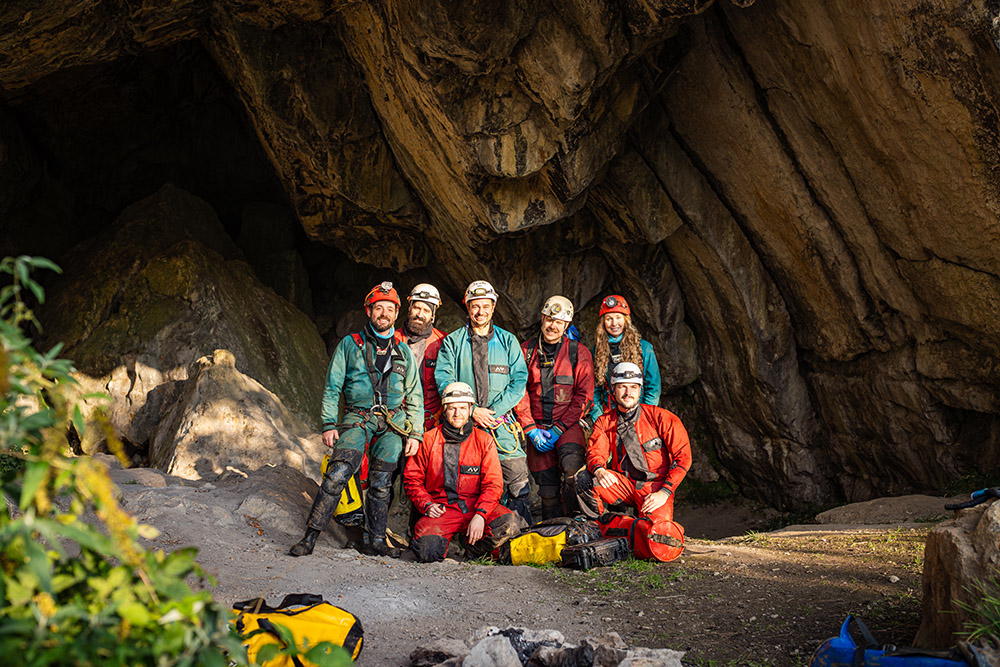
The biggest challenge was actually getting all the equipment to the dive site! Fortunately, we had incredible support from a fantastic 'sherpa' team: Davy Gerits, Chloé Catry, Tommy Vanassche, Wouter Vdb, Jente Wilms, and fellow diver Seppe Meyvis from Speleoclub Cascade. For the dive, Seppe and I each carried two 7L 300 bar tanks, plus all the necessary diving gear and lights. On top of that, we had two cameras – one for above ground and one for underwater – and some food for the journey. On the day itself, it nearly went sideways! I confidently walked up to the gate with the key from the Union Belge de Spéléologie… but it didn't fit! Normally, I pick up keys for established cave diving locations, but this dry cave required a different one. There I was, with six people ready for transport. Luckily, Seppe knew a local speleologist with the correct key, so we were able to enter the cave after all. Transporting the equipment all the way to Réseau Lemaire takes approximately an hour and a half. We took a bit longer because we were also taking photos along the way, which was a welcome break. It allowed us to rest with those heavy backpacks. Towards the end, you encounter two narrow constrictions, the second of which requires some squeezing. We attached a caving rope there to pull all the gear through. In moments like that, it’s crucial that everyone feels comfortable. We had people with varying levels of experience, and it's definitely a situation where you can feel uneasy, but thanks to the great atmosphere and the help we gave each other, everything went smoothly.
How did you approach your camera and lighting setup?
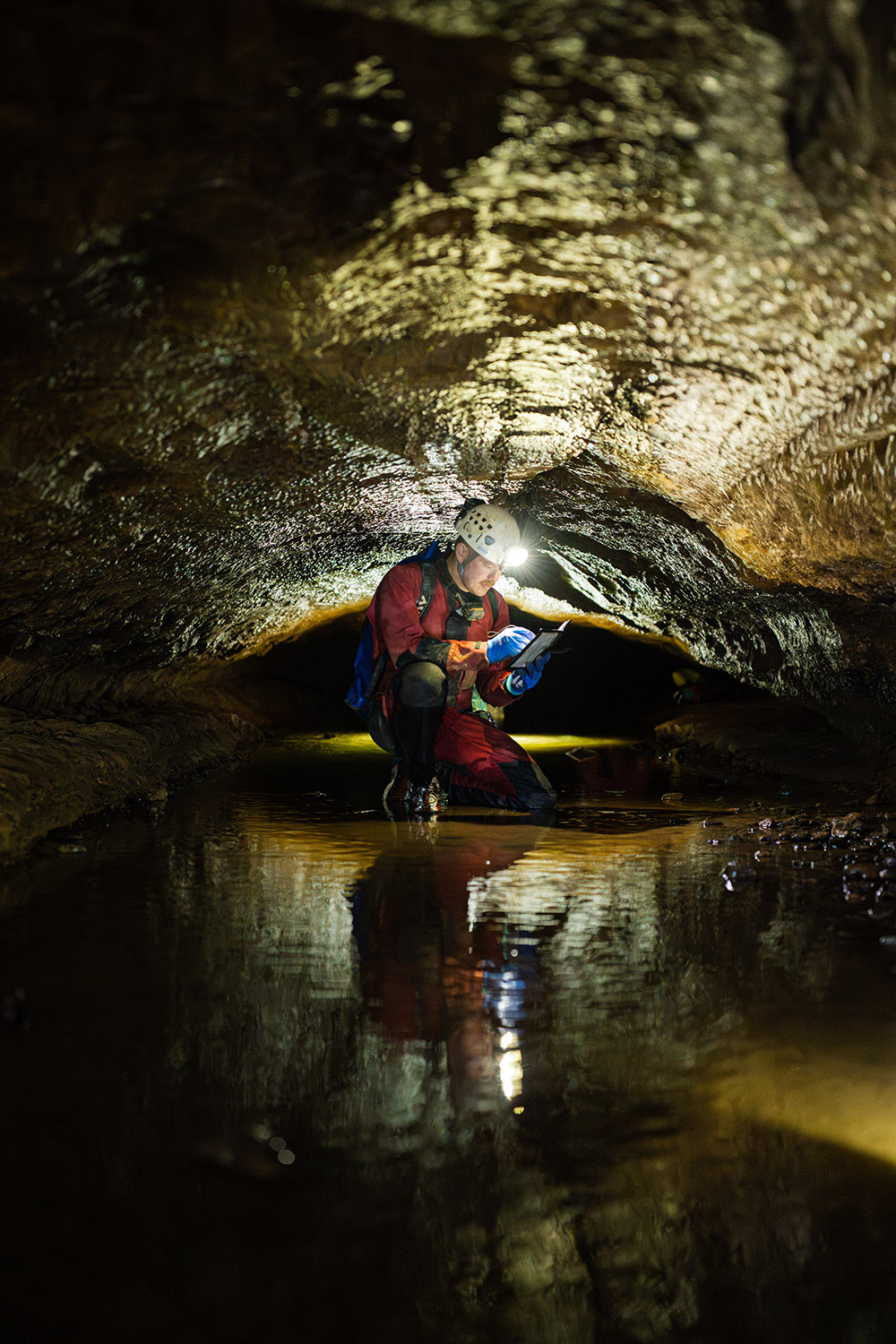
Normally, I like to treat an underwater cave like a photo studio, placing several lights strategically at the location. However, due to the fragile environment here, it was impossible to create such a light setup. Therefore, we used a 36,000-lumen lamp with a dome, carried by the model, as our primary light source. This worked effectively because the walls provided reasonably good reflection, giving us excellent illumination in the passages. This is in contrast to a mine with black marble or dark slate, where the light would simply be absorbed. Additionally, I had a 7,000-lumen video light mounted on the camera and another 7,000-lumen light on the model's shoulder.
How did the dive unfold? Was the visibility good?
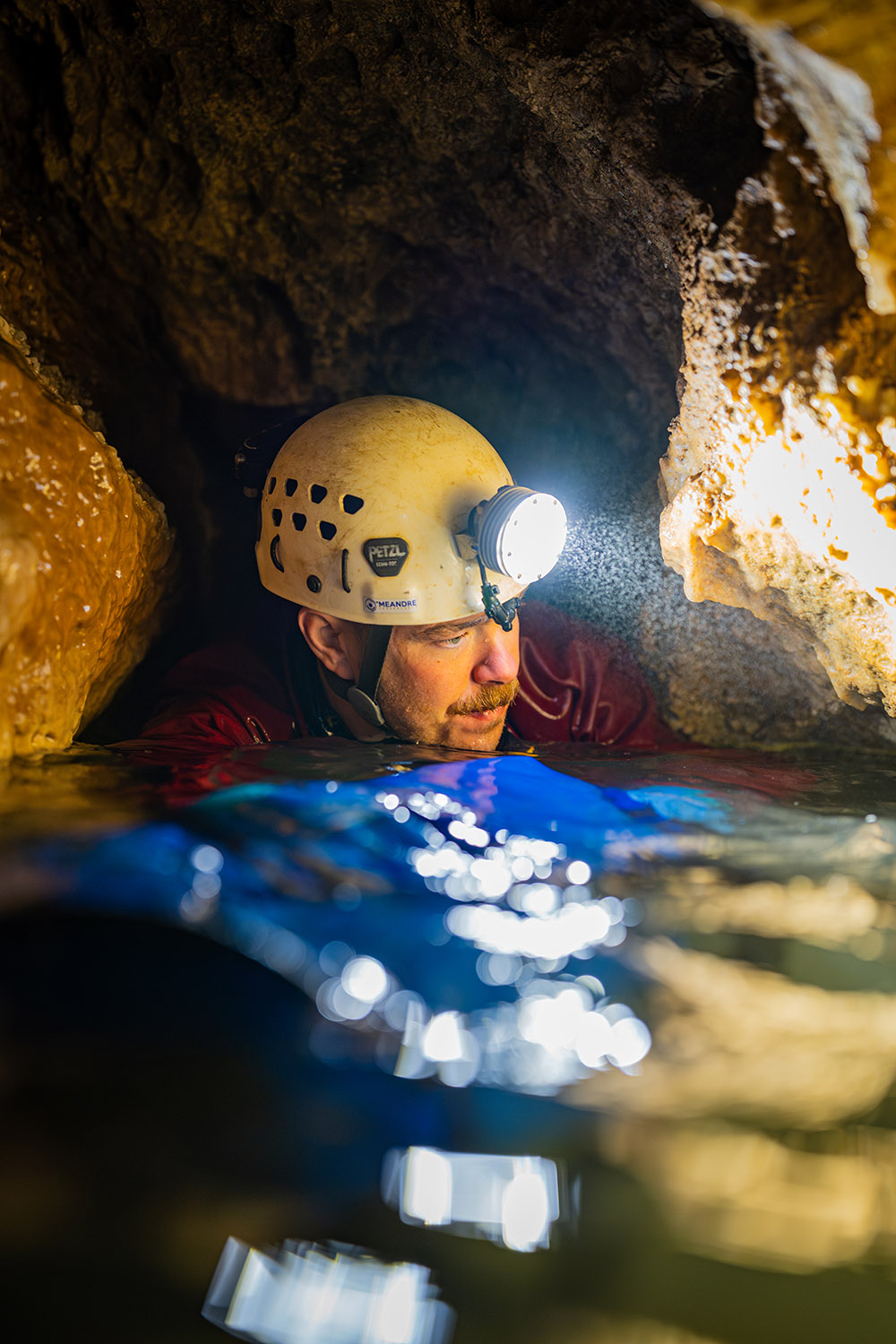
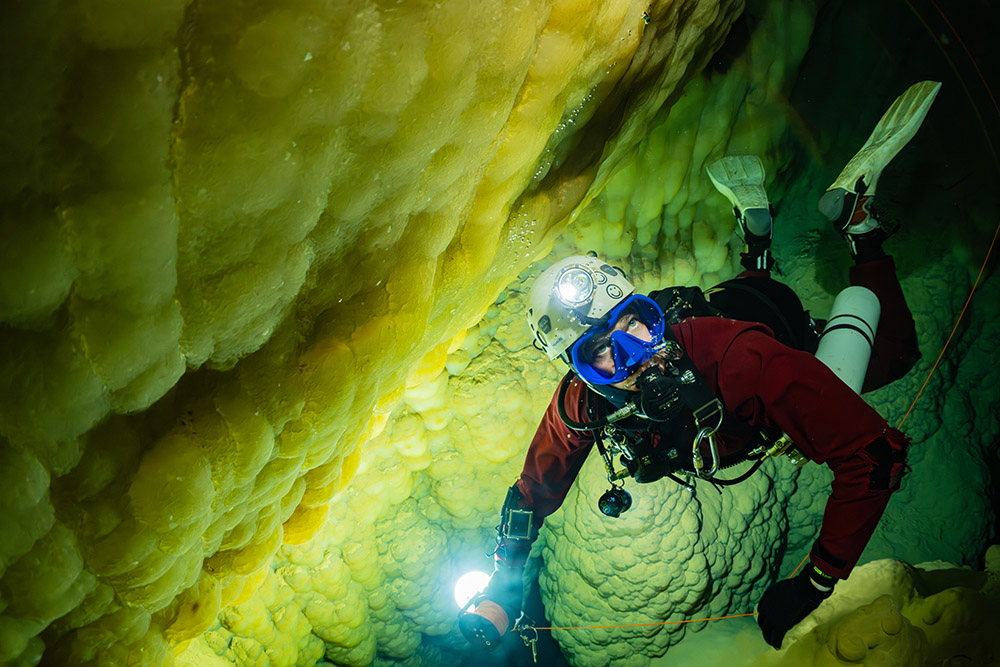
Upon reaching Lac du Réseau Lemaire, we quickly grabbed an energy bar, donned our dive gear, and immediately entered the water. I was only wearing a 3mm wetsuit – a suit that's ideal for getting to the waterline here. Of course, with just a 3mm wetsuit, you cool down quickly in 10-degree Celsius water. My secret weapon? A Venture Heat heated vest under the wetsuit, truly a lifesaver. I kept it on maximum the entire time. Once we were changed, Seppe secured a line so we would definitely find our way back to the surface. The descent began, and wow… beautiful formations everywhere, absolutely unseen! We immediately started taking photos! We had to work quickly because, even with excellent trim and buoyancy, it's virtually impossible not to stir up some dust. It wasn't long before sediment rose, forcing us to communicate with our heads just 10 centimeters apart. There are two zones; we first dived to the right, but it wasn't very productive. It also didn't help that my camera flashed a warning that the housing was no longer vacuum-sealed! At the surface, I quickly opened it, re-sealed it, and then re-vacuumed it using my mouth. In moments like that, a million thoughts race through your head: 'I rallied six people to haul all this equipment; I hope there's something usable and it wasn't all for nothing.' Fortunately, the housing was fine afterward, and we set off for dive two, this time in the left section. This part is somewhat larger, with magnificent walls covered in decorations consisting of calcite crystals – a very common mineral frequently found in crystal form in caves. Here, we thankfully managed to capture a series of successful photos. After this section, we continued a bit further along the other side towards the lake, where we took a few more shots. After just under an hour of diving, the adventure concluded, and we returned to the surface.
How large is Lac du Réseau Lemaire?
The gallery is a maximum of 10 meters deep. To the right, there's a small section that can be dived, featuring beautiful formations. To the left, you first dive through a narrow hole, leading you into a small tunnel, and then you emerge into a larger hall with stunning formations all around! That's where I took my favorite photo, showing Seppe swimming through the tunnel. You can proceed a bit further here, then past a restriction to a small chamber. A little way back, you re-enter the lake. Here, you can surface, and the team can watch you dive from the balcony. This creates a magnificent spectacle of light above the water. The sherpa team was happily enjoying warm noodles while we were immersed in the ice-cold water!
Does this exploration of Grotte Sainte-Anne leave you wanting more?
Absolutely! A day of exploration like that is physically demanding, and the equipment certainly takes a beating. That's precisely why I didn't wear a drysuit here. Shoving your new underwater housing and camera into a bag to scrape it along rocks as you ascend... there's definitely a degree of naivety involved in that. It was a phenomenal experience, and it certainly leaves me hungry for more. I'm always open to hearing from teams who know of beautiful, unique cave locations and are willing to give me the opportunity to document new places. I believe there are still many hidden gems out there to this day. The only challenge is finding them – and then getting to them!
 You're one of the guest speakers at Duikvaker 2026. What will you be showcasing during your presentation?
In Houten, on Sunday, February 1st, I'll be exclusively presenting film and imagery created by the team from the Lac du Réseau Lemaire expedition. We will delve into the equipment, the necessary experience required to safely undertake these types of dives, and all aspects of capturing the underwater photographs depicted.
At a glance
- What
- Interview met Arno Poppelaars over onderwaterfilmprojecten en duikervaringen.
- Where
- Grotte Sainte-Anne, Tilff, Wallonië.
- Who
- Arno Poppelaars, cinematograaf, duiker, filmmaker.
- Why
- Belichten van uniek onderwaterfilmwerk en de weg naar duikexpertise.
- How
- Via een interview waarin Poppelaars zijn achtergrond en projecten toelicht.
Key facts
- Arno Poppelaars is een bevlogen cinematograaf en filmmaker.
- Hij maakte professioneel beeldmateriaal van Grotte Sainte-Anne.
- Grotte Sainte-Anne is een ondergrondse duiklocatie in Wallonië.
- Arno Poppelaars begon pas twee jaar geleden met duiken.
- Hij behaalde een commercieel HSE-certificaat in Engeland.
- Zijn passie omvat technologie, drones en onderwatercamera's.
- Hij focust op de combinatie van technisch duiken en beeldcreatie.
- Hij is klaar voor grotere, complexere duikprojecten.
Frequently asked questions
Wie is Arno Poppelaars?
Wie is Arno Poppelaars?
Welk bijzonder project heeft Arno Poppelaars uitgevoerd?
Welk bijzonder project heeft Arno Poppelaars uitgevoerd?
Sinds wanneer duikt Arno Poppelaars?
Sinds wanneer duikt Arno Poppelaars?
Wat is de passie van Arno Poppelaars?
Wat is de passie van Arno Poppelaars?
Keywords
- Grotduiken Belgie
- Technisch duiken
- Spreker
- Onderwaterfilm
